Timo Mayer. The Man Who Left His Roots Behind.
Timo Mayer. The Man Who Left His Roots Behind.
Timo Mayer. The Man Who Left His Roots Behind.
Four centuries of family winemaking couldn't keep Timo Mayer in Germany. He found his way back to wine in Australia. Now his son is making it too.
Four centuries of family winemaking couldn't keep Timo Mayer in Germany. He found his way back to wine in Australia. Now his son is making it too.
People / Winemaker / Timo Mayer
People / Winemaker / Timo Mayer
.

There is something rather funny about Timo Mayer's life. He grew up in a German family that had been making wine for more than 400 years, left to see the world, spent several years enjoying the Australian coast and eventually became a winemaker.
Then he bought a vineyard.
Now his son Rivar makes wine too.
For a man who travelled halfway around the world instead of taking over the family business, Timo has ended up remarkably close to where he started. Although the journey involved a great deal more than changing the address on a wine label.
FOUR HUNDRED YEARS, AND OTHER PLANS
Württemberg, in southwest Germany, is a region of small vineyards and deeply established wine traditions. Red grapes are particularly important here: Trollinger, Lemberger and Spätburgunder, the German name for Pinot Noir.
Much of the region's wine has historically been consumed locally. Families work relatively small parcels, and wine is often as much a part of everyday life as it is a commercial product.
For Timo, growing up around vines was perfectly ordinary. His family had been involved in winemaking for centuries, but he wasn't particularly interested in spending his life following the same routine.
He wanted to travel.
His journeys eventually took him to the United States, where he met Rhonda, an Australian from Melbourne. By 1991, he had reached Australia, and the couple spent several years in Queensland, enjoying life near the coast.
When their first child arrived, they decided to move south to be closer to Rhonda's family. Timo needed a job, and the profession he had left behind suddenly became rather useful.
He studied winemaking at Charles Sturt University in Wagga Wagga and joined De Bortoli in the Yarra Valley in 1996, initially driving tractors.
Under winemaker Steve Webber, he encountered an Australian wine region beginning to reconsider its identity. The Yarra Valley's relatively cool climate offered possibilities for elegant, medium-bodied wines, yet some producers were still making the powerful, heavily ripe styles associated with Australia's international success.
Those weren't the wines Mayer particularly wanted to drink.
His next important move was to Gembrook Hill, a small family estate in the cooler Upper Yarra Valley, established by Ian and June Marks in 1983.
Gembrook Hill was already known for its distinctive Pinot Noir and Chardonnay. The vineyard sits in one of the coolest parts of the valley, where fruit ripens slowly and the wines can develop remarkable freshness and precision.
Mayer became its winemaker in 2000, the same year he launched his own label. He worked alongside the Marks family for seventeen years, eventually sharing responsibilities with their son Andrew.
In an interview published by Vininspo, Mayer described what made Gembrook Hill special: "you don't get that fruit anywhere else."
He was talking about the vineyard's particular combination of exposure, climate and fruit character. It was an expression of something he'd been interested in since arriving in the valley: wines that tasted of their growing conditions rather than a fashionable style.
For much of his career, Mayer was making Gembrook Hill wines while building his own business. The two projects developed alongside each other, but their vineyards and identities remained distinct.

A HILL WITH A PRICE TAG
In 1998, Timo bought a steep piece of former sheep-grazing land on Mount Toolebewong, near Healesville.
It had one obvious advantage: the price.
The site cost roughly half as much as neighbouring flatter land. Unfortunately, the discount came with a rather significant inconvenience. Tractors couldn't easily work the slope, and much of the farming would have to be done by hand.
There was also precious little soil. Beneath a shallow top layer, the ground was largely rock.
Other growers had passed it over.
Timo and Rhonda planted Pinot Noir, Chardonnay and Syrah, and named their vineyard Bloody Hill. Anyone who has spent a day working on a steep slope will probably understand why.
The first vintage arrived in 2002.
The hill's geography turned out to offer more than physical exercise. Its north-facing sections receive greater warmth and tend to produce riper, fruitier Pinot Noir. The cooler eastern exposure contributes more savoury character and firmer tannins.
For a small producer, having that variation within one vineyard is valuable. Different parcels give a winemaker different components to work with.
Bloody Hill became the centre of his estate. Mayer Wines would eventually expand to include wines made from grapes grown elsewhere in the Yarra Valley.
BRING BACK THE FUNK
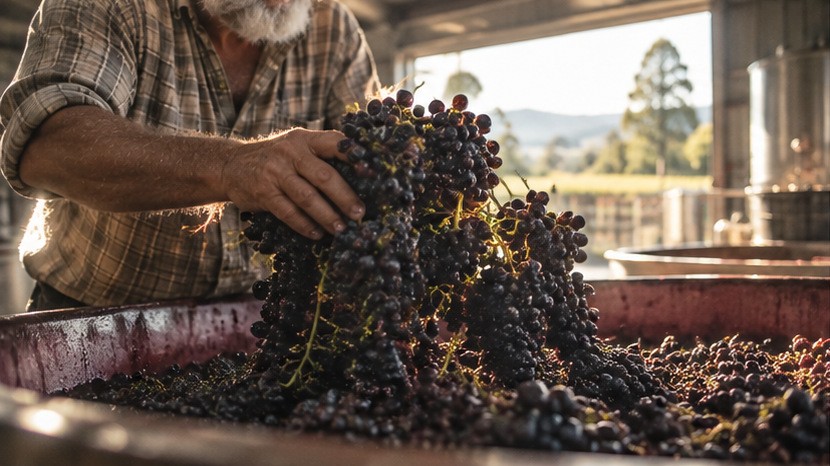
Mayer became known for his enthusiasm for whole-bunch fermentation, a technique that leaves the grape stems attached during fermentation.
Stems can change a wine considerably. Depending on their maturity and how the fermentation is managed, they may contribute herbal aromas, spice and additional tannin. They can also make a wine unpleasantly green or astringent if handled badly.
Mayer began experimenting with whole-bunch Pinot Noir in 2004, when the approach was still relatively uncommon in Australian winemaking.
Eventually, 100% whole-bunch fermentation became one of his signatures.
His Dr. Mayer Pinot Noir is known for its distinctive perfume, savoury herbs and pronounced structure. Other wines have used different proportions of whole clusters and destemmed fruit, creating quite different results from the same variety.
An earlier Bloody Hill Pinot Noir, for example, was made entirely from destemmed fruit, with some grapes picked deliberately early to bring freshness and firmer tannins. Close Planted Pinot Noir, meanwhile, combined whole bunches with destemmed grapes from a more densely planted section of the vineyard.
Mayer's famous Bring Back the Funk motto makes the operation sound wonderfully casual. The wines themselves involve rather precise decisions about picking dates, stem maturity and fermentation.
He has also applied whole-bunch techniques to Cabernet Sauvignon, producing a more aromatic, approachable style than might be expected from a young Cabernet made without fining or filtration.
For Mayer, the point has always been to make wines he enjoys drinking.
And sometimes that means doing something the neighbours haven't tried yet.
AN ITALIAN GRAPE IN AN AUSTRALIAN VALLEY
Then there's Nebbiolo.
Anyone familiar with Barolo or Barbaresco knows this isn't always the most accommodating grape. Nebbiolo can be wonderfully aromatic, with red cherries, roses, dried herbs and earthy notes. It also brings high acidity and tannins that can make a young wine feel rather stern.
Mayer's 2023 Nebbiolo offers an interesting alternative.
The grapes come from a north-facing slope at De Bortoli's Dixons Creek vineyard, in the northern Yarra Valley, rather than from Bloody Hill. The soils are sedimentary Humevale siltstones, and the relatively cool climate allows the grapes to retain freshness.
Mayer hand-picks the fruit and ferments it with 100% whole bunches using wild yeast in old oak. The wine then spends around a year on its lees, the fine sediment left after fermentation, before bottling without fining or filtration.
The finished 2023 wine has 13% alcohol, modest by the standards of many modern reds and particularly interesting for Nebbiolo, which needs sufficient ripeness to manage its substantial tannins.
Wine critics have described a light, bright purple colour, aromas of cranberries, red plum, rose petals and potpourri, and tannins that are firm enough to provide structure without overwhelming the fruit.
The producer's own tasting description adds sour cherries, pepper, alpine herbs and a savoury, almost game-like character.
What makes this particular Nebbiolo interesting is the combination. Whole-bunch fermentation contributes herbal and savoury complexity, while the wine retains a relatively light body and fresh fruit profile. The tannins remain unmistakably Nebbiolo, but the overall impression is more immediately inviting than some of the grape's famously austere expressions.
It's still worth giving the wine some air, and food wouldn't be a bad idea either.
A comparison with Nebbiolo from Piedmont would be particularly revealing. Look at the texture of the tannins, the weight of the fruit and how the floral aromas develop. The grape is recognisable in both places, but the wines tell you something about the different environments in which it grows.
Mayer's broader range follows a similar curiosity about what the Yarra Valley can produce. Alongside his estate-grown Pinot Noir, Chardonnay and Syrah, he has sourced grapes such as Gamay, Cabernet Sauvignon and Nebbiolo from other vineyards.
The distinction matters. Bloody Hill is a specific vineyard. Mayer Wines encompasses a wider collection of sites and varieties.

RIVAR HAD OTHER IDEAS TOO
Rivar Ferguson-Mayer grew up around the family vineyard, watching his father work and smelling fermenting grapes.
None of this made him desperate to become a winemaker.
In a 2023 interview with RAW WINE, he recalled being surrounded by the winery as a child but having little interest in working there himself.
His curiosity developed later, once he began to understand how many decisions went into making wine. Farming, fermentation, grape varieties, the differences between vineyards: the work turned out to be more complicated, and more interesting, than it had appeared when he was young.
He eventually travelled to Germany to gain experience.
In that interview, Rivar said his father had another winery there, where he learned more about whole-bunch fermentation. The precise history and current status of that German operation are not well documented, but Rivar's account makes clear that the family's winemaking connections with Germany hadn't simply disappeared after Timo settled in Australia.
When he returned, he began developing his own approach to the Bloody Hill wines.
Rivar has been explicit about his intentions: "my intention isn't to mimic my father's style."
His Bloody Hill Villages range provides a practical example.
In the RAW WINE interview, he described destemming three bins of fruit while leaving the fourth for whole-bunch fermentation. The combination allowed him to preserve the fruit's character while adding some of the herbal complexity and structure associated with stems.
That's a different balance from the 100% whole-bunch fermentations that made his father's reputation.
The Villages range also draws on different vineyard sites around the Yarra Valley, including Coldstream and other subregions. It gives Rivar room to explore how Pinot Noir, Chardonnay and other varieties respond to different growing conditions.
By January 2026, Australian wine merchant MW Wines was describing Rivar as taking increasing responsibility for the vineyard and winery, with his own ideas shaping the direction of Bloody Hill.
Timo, meanwhile, continues making wines under his own label.

THE LONG WAY BACK TO GERMANY
Timo left Württemberg, travelled to Australia and eventually built a vineyard of his own in the Yarra Valley. Rivar grew up on that vineyard, initially showed little interest in winemaking and later went abroad to learn the craft.
His destination was Germany.
There, according to his own account, he worked at another winery belonging to his father before returning to Australia and developing his own wines at Bloody Hill.
The family business Timo had left behind was never quite as far away as it first appeared.
There is something rather funny about Timo Mayer's life. He grew up in a German family that had been making wine for more than 400 years, left to see the world, spent several years enjoying the Australian coast and eventually became a winemaker.
Then he bought a vineyard.
Now his son Rivar makes wine too.
For a man who travelled halfway around the world instead of taking over the family business, Timo has ended up remarkably close to where he started. Although the journey involved a great deal more than changing the address on a wine label.
FOUR HUNDRED YEARS, AND OTHER PLANS
Württemberg, in southwest Germany, is a region of small vineyards and deeply established wine traditions. Red grapes are particularly important here: Trollinger, Lemberger and Spätburgunder, the German name for Pinot Noir.
Much of the region's wine has historically been consumed locally. Families work relatively small parcels, and wine is often as much a part of everyday life as it is a commercial product.
For Timo, growing up around vines was perfectly ordinary. His family had been involved in winemaking for centuries, but he wasn't particularly interested in spending his life following the same routine.
He wanted to travel.
His journeys eventually took him to the United States, where he met Rhonda, an Australian from Melbourne. By 1991, he had reached Australia, and the couple spent several years in Queensland, enjoying life near the coast.
When their first child arrived, they decided to move south to be closer to Rhonda's family. Timo needed a job, and the profession he had left behind suddenly became rather useful.
He studied winemaking at Charles Sturt University in Wagga Wagga and joined De Bortoli in the Yarra Valley in 1996, initially driving tractors.
Under winemaker Steve Webber, he encountered an Australian wine region beginning to reconsider its identity. The Yarra Valley's relatively cool climate offered possibilities for elegant, medium-bodied wines, yet some producers were still making the powerful, heavily ripe styles associated with Australia's international success.
Those weren't the wines Mayer particularly wanted to drink.
His next important move was to Gembrook Hill, a small family estate in the cooler Upper Yarra Valley, established by Ian and June Marks in 1983.
Gembrook Hill was already known for its distinctive Pinot Noir and Chardonnay. The vineyard sits in one of the coolest parts of the valley, where fruit ripens slowly and the wines can develop remarkable freshness and precision.
Mayer became its winemaker in 2000, the same year he launched his own label. He worked alongside the Marks family for seventeen years, eventually sharing responsibilities with their son Andrew.
In an interview published by Vininspo, Mayer described what made Gembrook Hill special: "you don't get that fruit anywhere else."
He was talking about the vineyard's particular combination of exposure, climate and fruit character. It was an expression of something he'd been interested in since arriving in the valley: wines that tasted of their growing conditions rather than a fashionable style.
For much of his career, Mayer was making Gembrook Hill wines while building his own business. The two projects developed alongside each other, but their vineyards and identities remained distinct.
A HILL WITH A PRICE TAG
In 1998, Timo bought a steep piece of former sheep-grazing land on Mount Toolebewong, near Healesville.
It had one obvious advantage: the price.
The site cost roughly half as much as neighbouring flatter land. Unfortunately, the discount came with a rather significant inconvenience. Tractors couldn't easily work the slope, and much of the farming would have to be done by hand.
There was also precious little soil. Beneath a shallow top layer, the ground was largely rock.
Other growers had passed it over.
Timo and Rhonda planted Pinot Noir, Chardonnay and Syrah, and named their vineyard Bloody Hill. Anyone who has spent a day working on a steep slope will probably understand why.
The first vintage arrived in 2002.
The hill's geography turned out to offer more than physical exercise. Its north-facing sections receive greater warmth and tend to produce riper, fruitier Pinot Noir. The cooler eastern exposure contributes more savoury character and firmer tannins.
For a small producer, having that variation within one vineyard is valuable. Different parcels give a winemaker different components to work with.
Bloody Hill became the centre of his estate. Mayer Wines would eventually expand to include wines made from grapes grown elsewhere in the Yarra Valley.
BRING BACK THE FUNK
Mayer became known for his enthusiasm for whole-bunch fermentation, a technique that leaves the grape stems attached during fermentation.
Stems can change a wine considerably. Depending on their maturity and how the fermentation is managed, they may contribute herbal aromas, spice and additional tannin. They can also make a wine unpleasantly green or astringent if handled badly.
Mayer began experimenting with whole-bunch Pinot Noir in 2004, when the approach was still relatively uncommon in Australian winemaking.
Eventually, 100% whole-bunch fermentation became one of his signatures.
His Dr. Mayer Pinot Noir is known for its distinctive perfume, savoury herbs and pronounced structure. Other wines have used different proportions of whole clusters and destemmed fruit, creating quite different results from the same variety.
An earlier Bloody Hill Pinot Noir, for example, was made entirely from destemmed fruit, with some grapes picked deliberately early to bring freshness and firmer tannins. Close Planted Pinot Noir, meanwhile, combined whole bunches with destemmed grapes from a more densely planted section of the vineyard.
Mayer's famous Bring Back the Funk motto makes the operation sound wonderfully casual. The wines themselves involve rather precise decisions about picking dates, stem maturity and fermentation.
He has also applied whole-bunch techniques to Cabernet Sauvignon, producing a more aromatic, approachable style than might be expected from a young Cabernet made without fining or filtration.
For Mayer, the point has always been to make wines he enjoys drinking.
And sometimes that means doing something the neighbours haven't tried yet.
AN ITALIAN GRAPE IN AN AUSTRALIAN VALLEY
Then there's Nebbiolo.
Anyone familiar with Barolo or Barbaresco knows this isn't always the most accommodating grape. Nebbiolo can be wonderfully aromatic, with red cherries, roses, dried herbs and earthy notes. It also brings high acidity and tannins that can make a young wine feel rather stern.
Mayer's 2023 Nebbiolo offers an interesting alternative.
The grapes come from a north-facing slope at De Bortoli's Dixons Creek vineyard, in the northern Yarra Valley, rather than from Bloody Hill. The soils are sedimentary Humevale siltstones, and the relatively cool climate allows the grapes to retain freshness.
Mayer hand-picks the fruit and ferments it with 100% whole bunches using wild yeast in old oak. The wine then spends around a year on its lees, the fine sediment left after fermentation, before bottling without fining or filtration.
The finished 2023 wine has 13% alcohol, modest by the standards of many modern reds and particularly interesting for Nebbiolo, which needs sufficient ripeness to manage its substantial tannins.
Wine critics have described a light, bright purple colour, aromas of cranberries, red plum, rose petals and potpourri, and tannins that are firm enough to provide structure without overwhelming the fruit.
The producer's own tasting description adds sour cherries, pepper, alpine herbs and a savoury, almost game-like character.
What makes this particular Nebbiolo interesting is the combination. Whole-bunch fermentation contributes herbal and savoury complexity, while the wine retains a relatively light body and fresh fruit profile. The tannins remain unmistakably Nebbiolo, but the overall impression is more immediately inviting than some of the grape's famously austere expressions.
It's still worth giving the wine some air, and food wouldn't be a bad idea either.
A comparison with Nebbiolo from Piedmont would be particularly revealing. Look at the texture of the tannins, the weight of the fruit and how the floral aromas develop. The grape is recognisable in both places, but the wines tell you something about the different environments in which it grows.
Mayer's broader range follows a similar curiosity about what the Yarra Valley can produce. Alongside his estate-grown Pinot Noir, Chardonnay and Syrah, he has sourced grapes such as Gamay, Cabernet Sauvignon and Nebbiolo from other vineyards.
The distinction matters. Bloody Hill is a specific vineyard. Mayer Wines encompasses a wider collection of sites and varieties.
RIVAR HAD OTHER IDEAS TOO
Rivar Ferguson-Mayer grew up around the family vineyard, watching his father work and smelling fermenting grapes.
None of this made him desperate to become a winemaker.
In a 2023 interview with RAW WINE, he recalled being surrounded by the winery as a child but having little interest in working there himself.
His curiosity developed later, once he began to understand how many decisions went into making wine. Farming, fermentation, grape varieties, the differences between vineyards: the work turned out to be more complicated, and more interesting, than it had appeared when he was young.
He eventually travelled to Germany to gain experience.
In that interview, Rivar said his father had another winery there, where he learned more about whole-bunch fermentation. The precise history and current status of that German operation are not well documented, but Rivar's account makes clear that the family's winemaking connections with Germany hadn't simply disappeared after Timo settled in Australia.
When he returned, he began developing his own approach to the Bloody Hill wines.
Rivar has been explicit about his intentions: "my intention isn't to mimic my father's style."
His Bloody Hill Villages range provides a practical example.
In the RAW WINE interview, he described destemming three bins of fruit while leaving the fourth for whole-bunch fermentation. The combination allowed him to preserve the fruit's character while adding some of the herbal complexity and structure associated with stems.
That's a different balance from the 100% whole-bunch fermentations that made his father's reputation.
The Villages range also draws on different vineyard sites around the Yarra Valley, including Coldstream and other subregions. It gives Rivar room to explore how Pinot Noir, Chardonnay and other varieties respond to different growing conditions.
By January 2026, Australian wine merchant MW Wines was describing Rivar as taking increasing responsibility for the vineyard and winery, with his own ideas shaping the direction of Bloody Hill.
Timo, meanwhile, continues making wines under his own label.
THE LONG WAY BACK TO GERMANY
Timo left Württemberg, travelled to Australia and eventually built a vineyard of his own in the Yarra Valley. Rivar grew up on that vineyard, initially showed little interest in winemaking and later went abroad to learn the craft.
His destination was Germany.
There, according to his own account, he worked at another winery belonging to his father before returning to Australia and developing his own wines at Bloody Hill.
The family business Timo had left behind was never quite as far away as it first appeared.
© 2026 WINE, LIVED
© 2026 WINE, LIVED
WINE IS NEVER JUST WINE
WINE IS NEVER JUST WINE