.
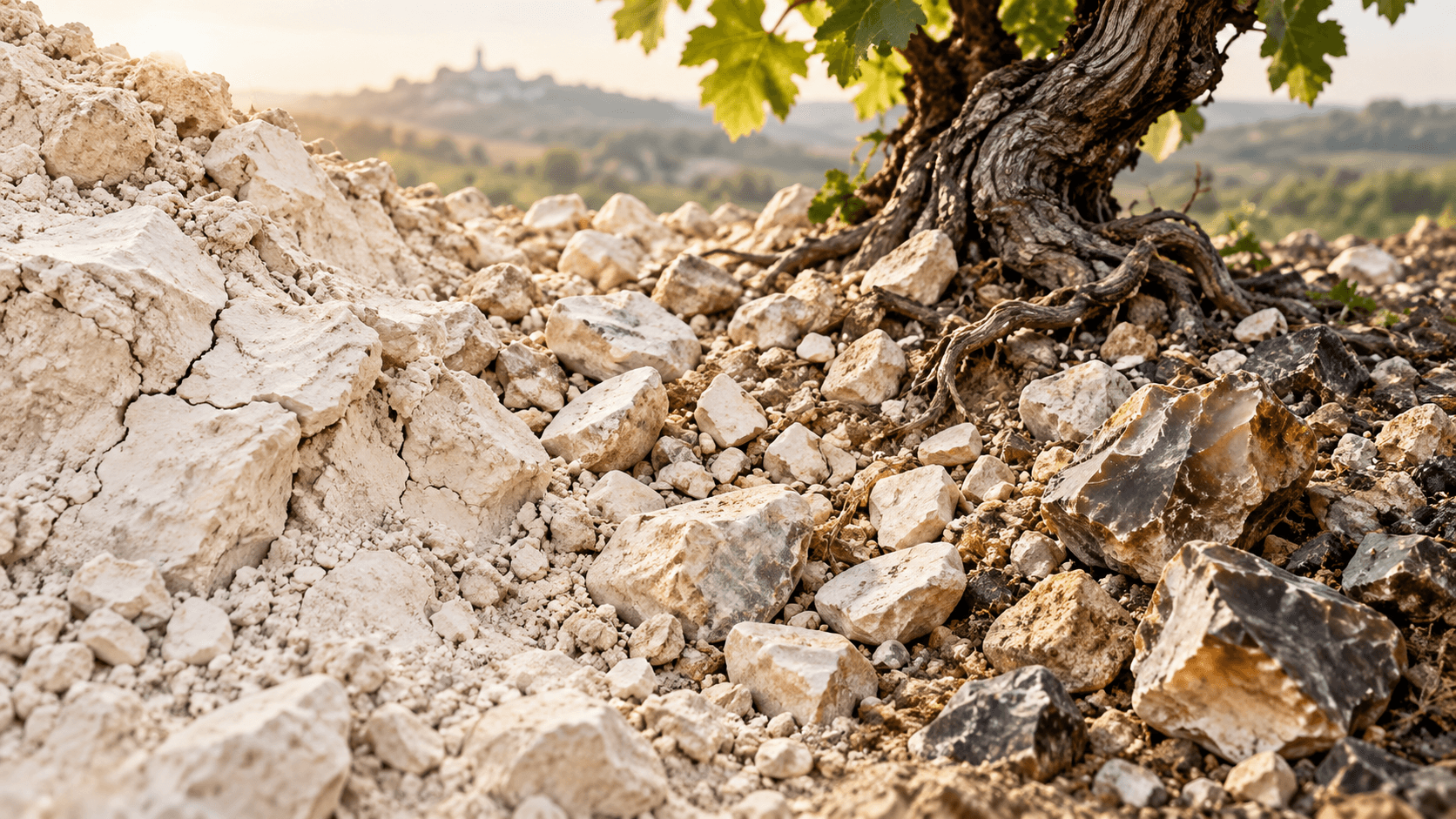
FIRST, THE STONE
Pick up a piece of silex and it feels almost too dramatic for Sauvignon Blanc.
Hard. Sharp-edged. Grey, amber, sometimes nearly black. Smooth in one place, fractured in another. Strike one piece against another and suddenly the vocabulary surrounding Sancerre begins to make intuitive sense: flint, smoke, spark, stone.
Silex is simply the French word for flint. In Sancerre, it is found particularly in the eastern part of the appellation, closer to the Loire, where flint occurs within clay-rich soils. It represents only a minority of the vineyard area, but its reputation is much larger than its physical presence.
Perhaps that is because silex is unusually easy to romanticise.
You can hold it in your hand.
You can photograph it.
You can put the word on a label.
And once someone tells you that a wine grown here tastes smoky and mineral, it becomes very difficult not to connect the glass with the stone beneath the vine.
But that connection is where things become interesting.
THREE WORDS THAT
The geology of Sancerre is often introduced through three names.
Terres blanches — clay and limestone.
Caillottes — stony limestone.
Silex — flint within clay-rich soils.
It is a useful map. It is also an imperfect one.
Travel through the vineyards and the borders become less elegant than they appear in a wine textbook. Soil compositions change from slope to slope and sometimes within the same site. Even the places described as silex are not beds of pure flint: clay remains fundamental to the soil in which the vines actually grow.
That messiness matters.
Terroir becomes less interesting when we reduce it to three boxes and three corresponding flavours.
DOES SILEX HAVE A ?
Ask people to describe Sauvignon Blanc grown on silex and certain words appear again and again:
smoky.
flinty.
spicy.
tense.
mineral.
These associations are not invented out of nowhere. Producers and critics have described wines from the flinty eastern soils of Sancerre in precisely this vocabulary for years. Even recent guides still talk about the powerful smoky minerality associated with silex.
The seductive mistake is what happens next.
We start imagining that we are literally tasting the rock.
As though a piece of flint dissolves underground, travels through the roots and reappears in the glass as the smell of struck stone.
Wine is not that simple.
Soil matters because it shapes the environment in which the vine lives. Clay, stone, drainage, water availability, exposure and the way a vineyard warms and cools all become part of the conditions a grower must work with.
But the language we use when tasting is something else again.
“Flinty” is a sensory comparison.
“Smoky” is a sensory comparison.
“Mineral” may be one of the most evocative — and least precisely defined — words in the entire wine vocabulary.
That does not make those descriptions meaningless.
It simply means they are descriptions, not geological laboratory reports.
CAN YOU TASTE IT ?
There is a useful test for every beautiful wine story:
remove the label.
Sancerre and neighbouring Pouilly-Fumé are both based largely on Sauvignon Blanc, share related soil types and sit on opposite sides of the Loire. Experienced tasters often describe distinctions between them, but those distinctions can be subtle rather than absolute.
That does not diminish terroir.
For me, it makes terroir more convincing.
The most interesting wine regions are not machines where Soil A reliably produces Flavour A.
They are systems.
Geology interacts with water.
Slope interacts with sunlight.
Vintage interacts with picking date.
Vine interacts with farmer.
Wine interacts with expectation.
And finally, all of it interacts with the person drinking it.
SO WHY DOES SILEX ?
It is that it makes us curious about everything it cannot explain.
Why does one grower make something razor-sharp while another produces something broader?
Why does one vintage smell almost smoky while another feels dominated by fruit?
How much of what we recognise in the glass comes from the vineyard — and how much comes from the vocabulary we have learned to bring to it?
Once you begin asking those questions, terroir becomes richer rather than simpler.
Silex is easy to see. Its effect on wine is much harder to prove.
And perhaps that is exactly why the stone matters.
Not because it gives us a perfect answer.
Because it gives us a way into the landscape.
The flint matters.
So does the clay around it.
The slope.
The season.
The grower.
And eventually, the language we use when the wine reaches the table.
Wine is never just wine. Sometimes it begins with a stone.